
Share this
For new business owners, there can be a steep learning curve when it comes to finances. This is no less true when it comes to business bank accounts. However, there are several reasons why a business owner could benefit from having their own designated business checking account, and this rings true even for sole proprietors, freelancers, and gig workers.

Before getting into the why, let’s break down how these two account types differ.
Business Checking vs. Personal Checking: At a Glance
| Business Checking | Personal Checking | |
| Liability Protection | Helps preserve the liability protection of an LLC or corporation | Mixing funds can weaken it |
| Business Funding | Easier to qualify | Harder to qualify |
| Application Requirements | EIN (SSN for sole props), owner IDs, formation documents, physical business address | ID, SSN, proof of address |
| Monthly Fees | Can be higher, may be waived by meeting minimum balance | Low to none, may be waived by meeting minimum balance |
| APYs | Variable, minimum to earn can be higher than with personal checking | Variable |
| Monthly Transaction Limits | Hundreds, sometimes unlimited | Often unlimited |
| Cash Deposit Limits | Unlimited; amount of free cash deposits may be limited | Unlimited |
| Business Software Integrations | Accounting, payroll, payment processing, others | Basic bank feeds only, if any |
| Invoicing | Can be built-in | Not offered |
| Employee Access | Multi-user access, customizable permissions, employee debit cards, spend controls | Joint owners or authorized users only |
Application Requirements

To qualify for a business bank account, you will need to present the following:
- Your business’s EIN. Sole proprietors may be able to use their SSN instead, although they can apply for an EIN online through the IRS if desired.
- Government-issued IDs for all of the business’s beneficial owners, who are those that own 25% or more of the business, as well as one individual with significant control over the business, such as a CEO or managing member.
- A physical U.S. address and your business’s contact information
- Your formation documents, the specific ones varying by the type of business entity:
- Sole proprietorship: DBA certificate if operating a name other than your legal name
- LLC: Articles of Organization
- Partnership: Partnership Agreement
- Corporation: Articles of Incorporation (some banks also ask for bylaws or a banking resolution)
For a personal checking account, the application process is a bit simpler. You’ll still need to show a government ID, your SSN, and proof of your address, but business formation documents aren’t part of the picture.
Monthly Maintenance Fees and Account Minimums

Comparing fees across checking accounts is an absolute must before applying. Fees can add up significantly over time if you’re not careful.
One of the most notable is a monthly maintenance or service fee. Some banks charge this fee, although many others don’t. It’s more common to face monthly charges if you’re using a physical bank rather than an online-only bank, as maintaining physical branches comes at a cost.
Of checking accounts that charge a monthly fee, business accounts tend to have somewhat higher fees than personal ones. But before writing off a bank account completely based on its stated monthly fee, check to see if it’s waivable by, for example, meeting a specified minimum balance requirement — whether that minimum is a flat amount, an average, or a combined balance across multiple account types.
Generally speaking, you’ll see higher minimum balance requirements for business checking accounts than personal checking accounts. This is also true for the minimum opening deposit, if there is any.
Annual Percentage Yield

Some checking accounts are interest-bearing, with some categorized as “high-yield.” This means that the APY (the rate of interest you can expect to earn over the course of one year, including compounding) is far higher than what is typically seen in checking accounts. The more money you have in your account, the more interest you’ll earn, as compound interest can add up considerably.
Note that the APY you see advertised doesn’t necessarily apply to all of your funds. There can be minimum balance requirements to meet a certain APY, and these requirements are generally higher for business rather than personal accounts. APYs can also be tiered, with different APYs applying to different balance ranges.
Transaction Limits
Because businesses are expected to spend and accept more money during the month than an individual, transaction limits tend to exceed those of personal checking accounts. What is considered a transaction depends on your bank’s definition, but the limit may include things like ACH transfers, checks paid, checks deposited, or ATM deposits.
Typically, wire transfers are separate and have their own limits. Usually, you will only get a few free wires monthly, with fees coming into play past that point.
For a business, the free monthly transaction limit can extend into the hundreds, or there can be no limit at all. If there is a transaction limit, your bank will charge a small fee for any transaction that exceeds this threshold.
Most personal checking accounts don’t limit the number of monthly transactions, though they may have lower daily limits on the dollar amount you can spend, withdraw, or transfer.
Cash Deposits

If you’re operating a business that deals with significant amounts of cash, such as a restaurant or retail store, you’ll want to choose a checking account that makes it easy to deposit cash. For both personal and business checking accounts, there are usually no limits on the amount of cash you can deposit.
However, business bank accounts sometimes impose a limit on the amount of free cash deposits you can make over the course of one month, with fees for deposits above this point. These limits are variable, ranging from $5,000 to $20,000 or more.
Keep in mind that for both types of checking accounts, banks are required to report cash transactions of more than $10,000 in a single business day to the federal government, which is designed to combat money laundering. Breaking a deposit into multiple smaller deposits to avoid the reporting threshold is considered structuring, which is illegal.
If you need to make cash deposits, you’ll likely want to use an in-person bank rather than one that is online-only. Online banks generally don’t allow cash deposits, although some will let you make them through an ATM or a third-party retailer. It’s here that you should also consider the size of a bank’s ATM network; larger networks are preferable, as there can be fees involved with using out-of-network ATMs.
Business Software Integrations
If you want to integrate your business transactions with your accounting software, payroll provider, or payment processor, a business bank account is the better choice. Often, there are native two-way syncs with popular solutions, and this capability isn’t something that you’ll get from a personal checking account.
Invoicing

Many business checking accounts, especially those through online banks, let you send invoices directly through your account. This prevents you from having to use an external invoicing platform. If you send frequent invoices, this could be a handy feature to look for, and you won’t come across this in a personal checking account.
Employee Access
If your business has employees and you want multiple users to be able to access your account, you will need a business checking account for this purpose. You may be able to go in and customize the level of access that each employee has, giving some of them view-only access with others able to make transactions.
Business bank accounts also allow you to issue debit cards to your employees, with both physical and virtual cards being common options. Many banks let you create an unlimited number of employee debit cards, while some have a cap, such as 50. You may also be able to control employee spending by setting overall spending limits on the cards or restricting spending to certain categories, like restaurants or travel.
Why Open a Business Checking Account

As you can see just in the differences between these account types, there are several upsides to opening a business checking account. However, there are still many other benefits you’ll see from separating your business finances from your personal finances.
Easier Recordkeeping and Tax Filing
If your business’s funds are kept in their own account, it makes recordkeeping much easier, and business transactions don’t get tangled up among personal ones. This can simplify your day-to-day bookkeeping, as well as tax filing. For sole proprietors or single-member LLCs, it makes it more likely that the information you submit on Schedule C will be accurate, along with your quarterly estimated tax payments.
Liability Protection
Business structures like LLCs, LLPs, and corporations are designed to separate business liabilities from your personal ones, meaning you should not be held personally accountable for business debts or other issues. Sole proprietorships don’t offer this protection, regardless of the type of bank account you use.
Of course, even if you’ve formed an LLC, you’re not totally out of the woods. It’s possible that a court could still find business owners personally liable for corporate liabilities. You can reduce the odds of this happening by keeping your business and personal finances clearly separated from each other.
Business Funding
If you intend to apply for a business loan or line of credit at some point, you’ll want to have a business checking account. For many lenders, a separate business bank account is either required or is strongly preferred.
Professionalism and Brand Reputation
Opening a business checking account can make your business come across as more professional. For example, if a customer wants to write a check to pay you and you only have a personal checking account, they would have to make the check out to you personally. If you have a business account, they could make the check out to your business instead. Many banks won’t let you deposit a check made out to your business into a personal account.
How to Compare Checking Accounts Online
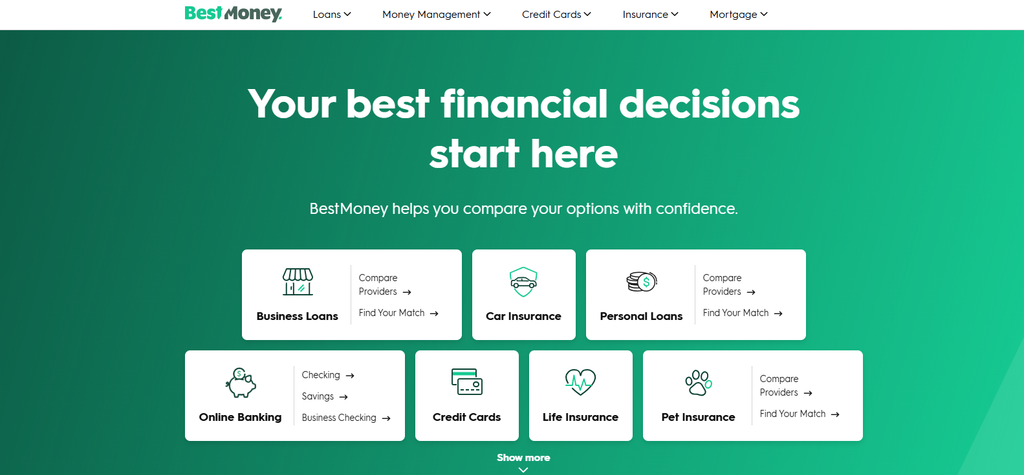
Even if you’ve decided between a business and personal checking account, this doesn’t mean your work is done. You’ll want to compare details across banks, such as fees, account minimums, APYs, and others.
This can be difficult and time-consuming to do on your own, as it would involve visiting several bank sites and toggling between numerous tabs. Instead, you can use a financial comparison site like BestMoney, which shows you multiple options on one page and highlights the main features.
Deciding Between Business and Personal Checking

Sometimes, the decision of whether to open a business or personal checking account is rather clear-cut, while other times, it’s more nuanced.
Most businesses will want a designated business account because of the account features, organizational and tax considerations, liability protection, and the ability to qualify for business loans. However, some business owners can do just fine with a personal account, although this is really only appropriate for freelancers, those with side gigs, or other sole proprietors with small operational needs.
Take the time to consider which type of account would be the best fit for your business, as making the right choice can help you avoid major headaches in the long run.