
Share this
Making a decision on a new loan, credit card, insurance policy, or bank account is never easy. You have several options these days, but this can often only make the decision process more intimidating, especially if you’re digging through each financial institution’s website one at a time.
There’s actually a more efficient approach: visiting dedicated financial comparison websites. The best of these maintain high editorial standards, so you can be confident that you’re getting an accurate look at your options.
Here are some of the best websites for comparing financial products:
At a Glance
| Product cate- gories | Selec- tion size | Filtering | Ratings & reviews | Best for | |
| Best-Money | Loans, insur- ance, banking, cards, debt consoli-dation, money transfer, invest-ments, gold/silver IRA, tax relief | Small (5–10 per category) | Basic | Editorial only, score out of 10 | User experi- ence |
| Nerd-Wallet | Cards, banking, loans, insur- ance, invest-ments, tax software, small business | Small to moder- ate (7–10 per category) | Strong for cards and mortgages | Editorial only, 5 stars | Finan- cial educa-tion |
| Bank- rate | Mort- gages, banking, cards, loans | Varies widely (9 personal loans, 91 savings accounts) | Strongest for mortgages | Editorial + user, 5 stars | Mort- gages |
| Wallet-Hub | Cards, loans, banking, plus local advisor match- ing | Largest (1,500+ cards, 1,000+ savings accounts) | Deep across categories | Editorial + user, 5 stars | Credit cards |
| Finder | Banking, invest- ing, lending, business | Moder- ate to large (18–51 per category) | Deep, including crypto rewards | Finder Score out of 10, some user reviews | Crypto-currency |
BestMoney: Best for User Experience
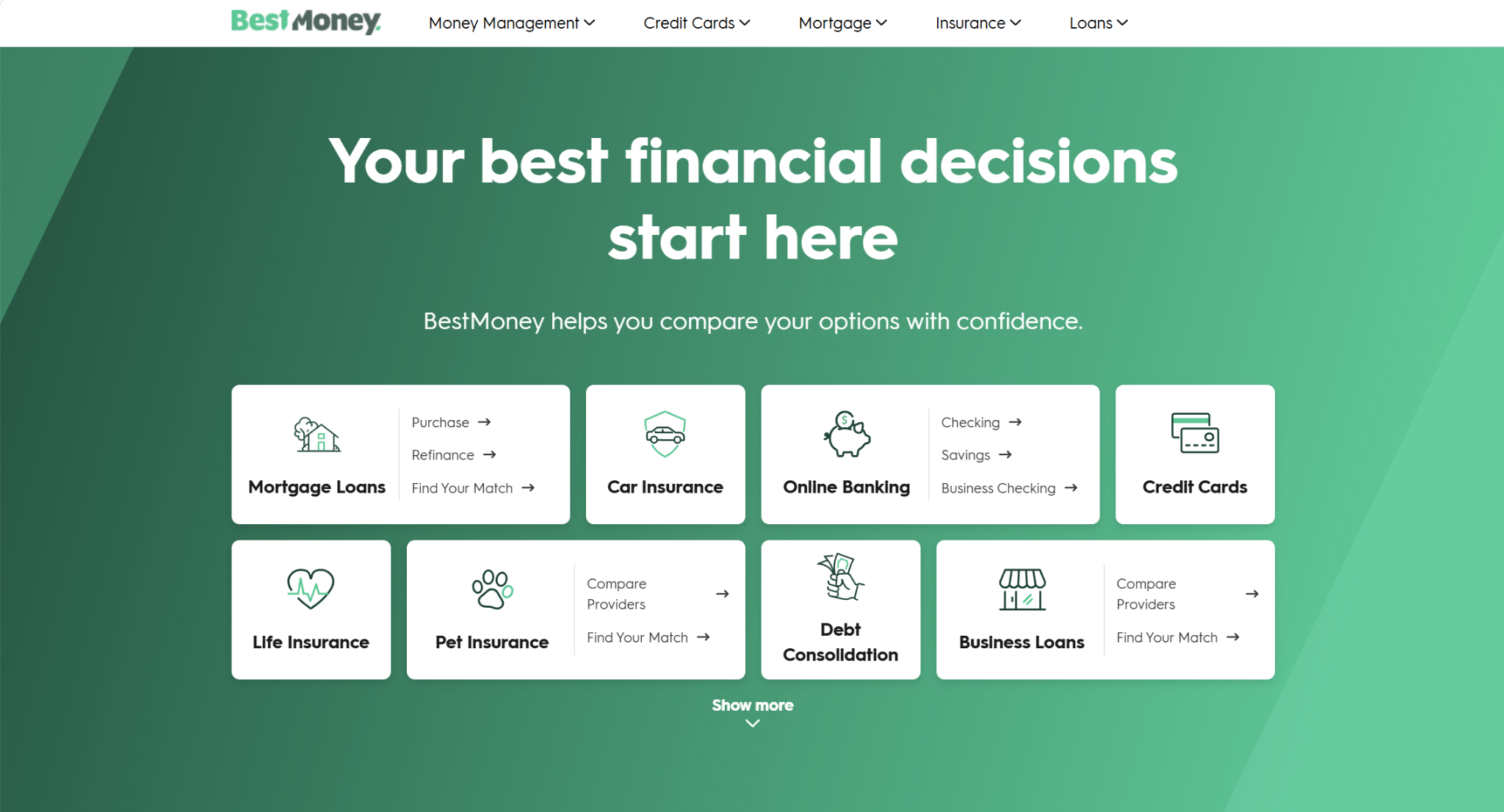
BestMoney is one of the most straightforward comparison sites, with a layout that’s easy to navigate and compare. It doesn’t focus too heavily on any single aspect of personal finance, covering products from pet insurance to tax relief.
Product Coverage
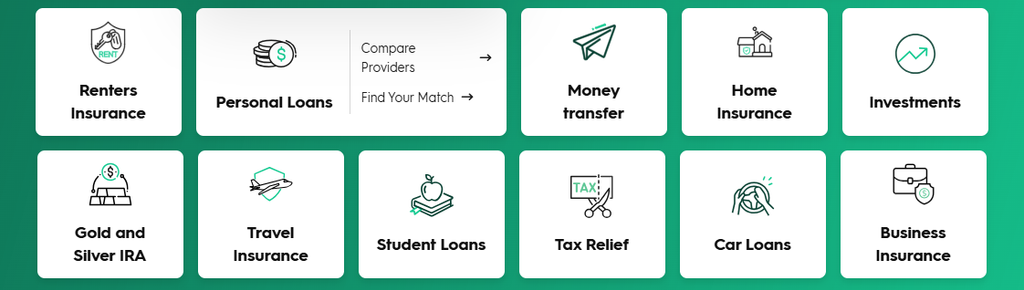
BestMoney’s product coverage spans several categories, including:
- Loans (mortgage, business, personal, student, car)
- Insurance (car, life, pet, renters, home, travel, business)
- Online banking (checking, savings, business checking)
- Credit cards
- Debt consolidation
- Money transfer
- Investments
- Gold and silver IRA
- Tax relief
This list is far more expansive than many competing sites, but once you dive into each, you’ll find that you don’t get too many choices. For example, with a debt amount of over $15,000, it showed me just five lenders to compare for the purpose of debt consolidation. It gave me nine options for pet insurance, seven for renters insurance, and ten for investment accounts.
This is enough to start comparing, but some other sites have far larger product databases. Still, for those wanting a less overwhelming option, BestMoney could be a good fit.
Filtering Depth
Because BestMoney doesn’t have a ton of products to choose from, there aren’t too many filters. But certain product categories do have some helpful ones, such as:
- Life insurance: Age and income
- Credit cards: Cashback, balance transfer, travel, rewards, no annual fee, 0% APR, business
- Personal loans: Loan purpose, loan amount, annual income, credit score
Ratings and Reviews
BestMoney’s editorial team assigns each listing a score out of ten possible points, weighing factors like popularity, brand reputation, features, and benefits. Most products also have a detailed write-up, discussing characteristics like the interest rates, fees, features, security, application process, user experience, and customer service.
Financial Education
Beyond straight comparison, BestMoney also has informative articles that discuss whether you need life insurance during retirement, how many credit cards to have, and the difference between a bank and a credit union. It also has interactive calculators for CDs, savings, balance transfer, and life insurance coverage.
Pros
- Easy to navigate
- Wide range of product categories
- Editorial ratings and reviews
Cons
- Limited number of product choices
- Few filtering options
- No user ratings or reviews
NerdWallet: Best for Financial Education
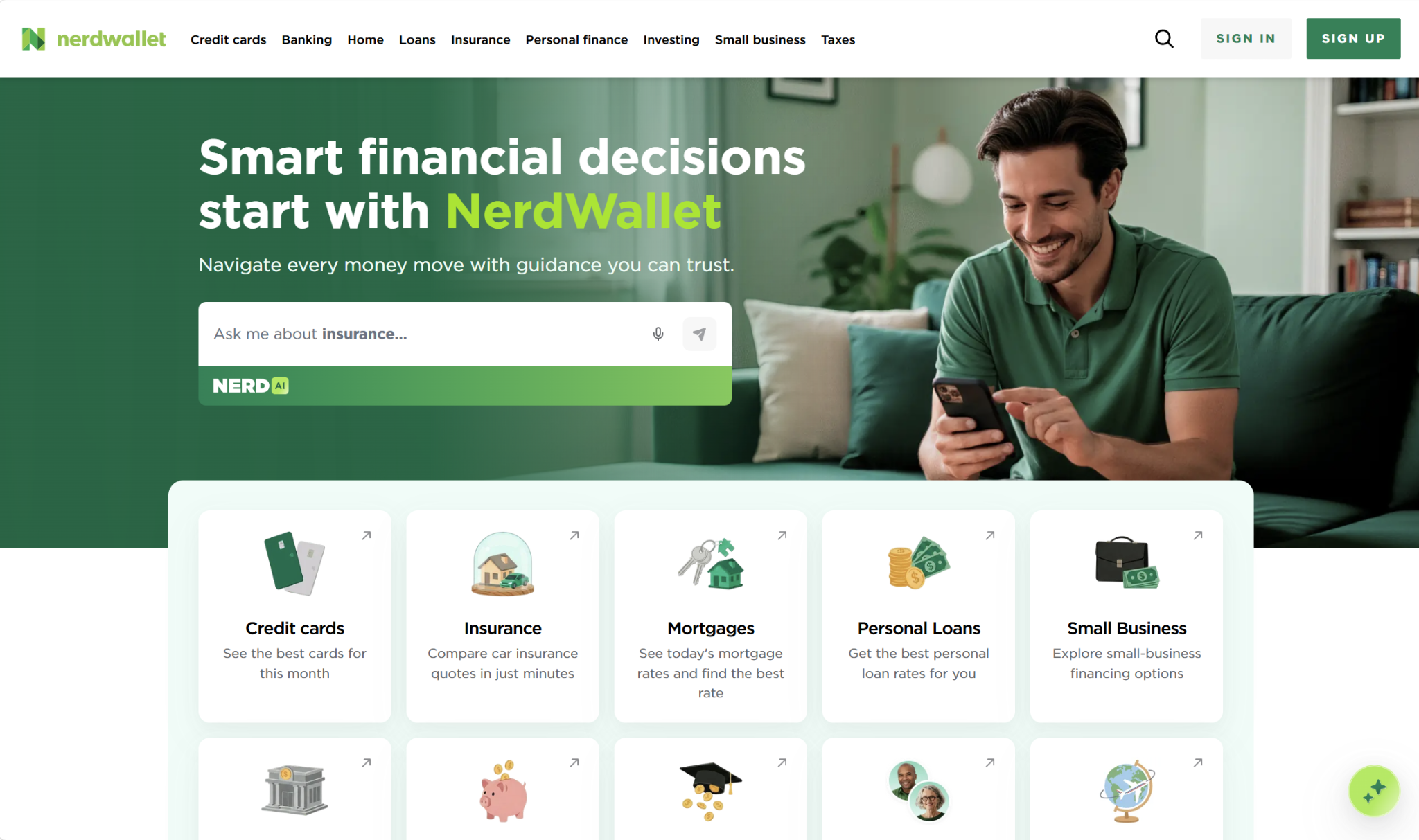
Of all the comparison sites available, NerdWallet might be the most recognizable name. It’s commonly used for financial comparison, but you can also create an account and track your personal finances.
Product Coverage
NerdWallet rivals BestMoney when it comes to the sheer volume of product categories:
- Credit cards
- Banking (savings accounts, CDs, checking accounts)
- Loans (mortgage, personal, student, auto)
- Insurance (auto, life, home, pet, renters, Medicare)
- Investments
- Tax prep software
There are also plenty of business-specific topics, such as finding the best accounting software and payment processors.
Like with BestMoney, there aren’t too many options to pick from, although some categories have more than others. For instance, it gave me seven options for renters insurance and ten for high-yield savings.
Filtering Depth
One area where NerdWallet shines is with its filtering system. For the product categories with a higher number of choices, there are in-depth filters you can use to find exactly what you need.
This is especially true for credit cards and mortgages. Filters for credit cards include cashback, balance transfer, travel, sign-up bonus, student, secured, and so on. For mortgages, you’ll see filters for FHA, VA, low credit, construction, credit union, and jumbo loans, among many others.
Ratings and Reviews
NerdWallet’s editorial team provides ratings and reviews for many of the products it presents. Ratings are out of five stars, and although the exact methodology varies depending on the product type, factors like the features and customer experience are commonly focused on. The reviews cover these factors on a deeper level, so you can get a better sense of how NerdWallet’s team landed on a particular score.
Financial Education
NerdWallet’s site is filled with guides and other resources you can use to further your general knowledge of personal finance, such as “Applying for a Credit Card” and “Emergency Fund: What It Is and Why It Matters.”
There’s also a dedicated personal finance section that gets into topics like tracking credit, managing money, making money, managing debt, and travel. Plus, you can play around with calculators for credit cards, banking, mortgages, and life insurance, among others.
Pros
- Plenty of product categories
- Includes small business resources
- Several financial calculators
Cons
- Not as many options as some competitors
- No user ratings or reviews
- Somewhat confusing ratings methodologies
Bankrate: Best for Mortgages
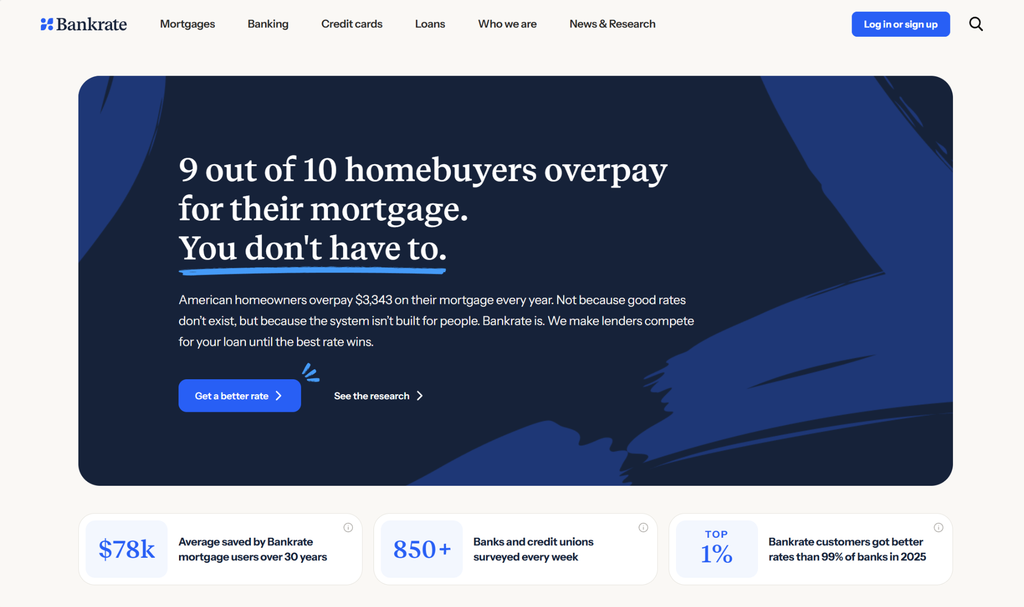
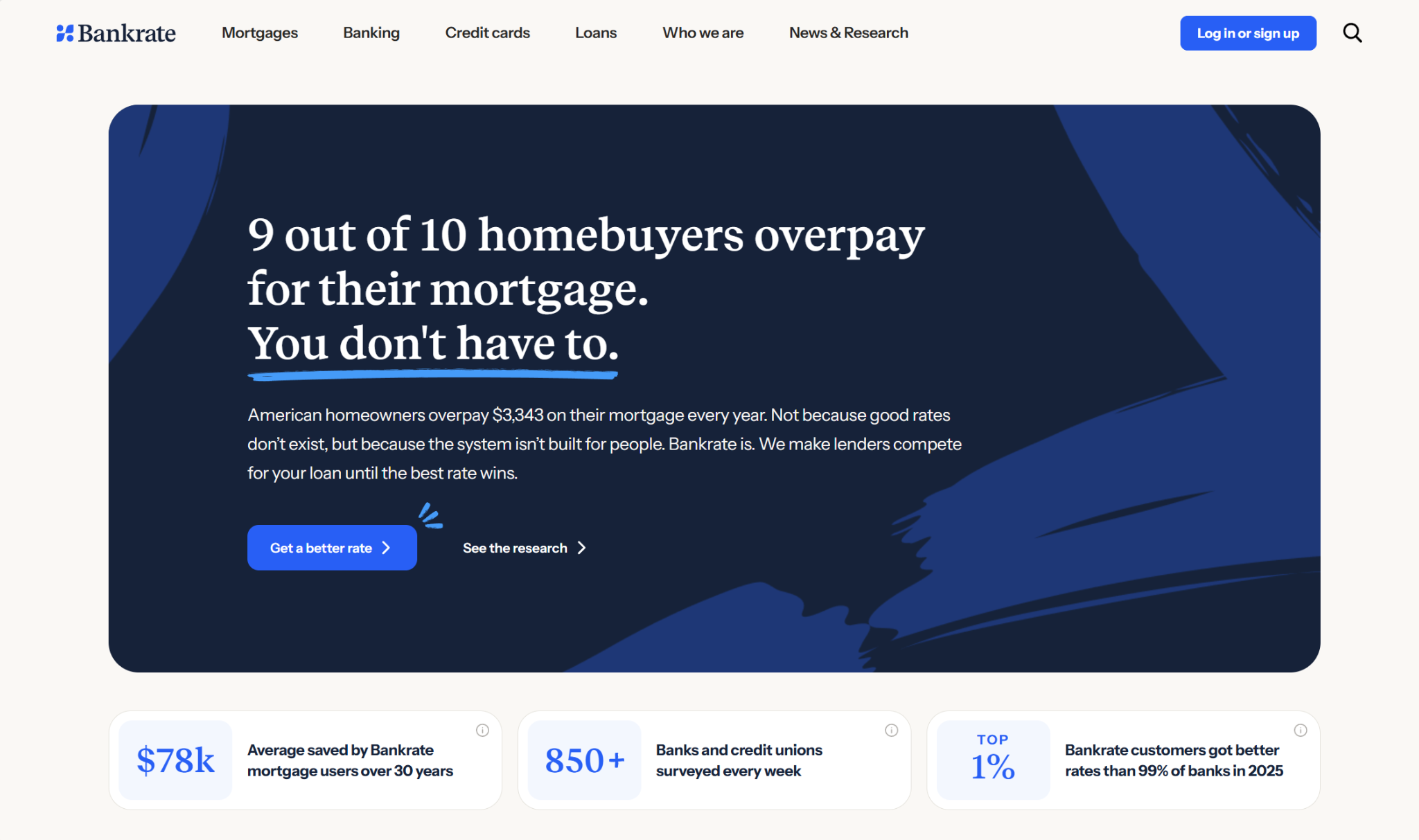
Bankrate is highly data-driven, with a strong focus on interest rates, especially for mortgages. Like NerdWallet, you can sign up for an account if you’d like, though you can still browse the site without one. But with an account, you can access mortgage rate alerts, save quotes, and connect with lenders.
Product Coverage
Bankrate is best known as a mortgage research tool, covering loans for purchasing and refinancing, HELOCs, and home equity loans. But it spans beyond mortgages as well, with banking (checking, savings, money market, CDs, banks), credit cards, and loans (personal, auto, student, small business) also falling within its scope.
For some product categories, Bankrate gives you plenty of choices; for others, the list is shorter. For instance, it showed me rates for 91 high-yield savings accounts, but its “best personal loans” round-up only had nine entries.
Filtering Depth
Bankrate has several filters that can help you. This is especially true for mortgages, which go beyond the basics (ZIP code, purchase price, down payment, and credit score) and get into loan terms, FHA and VA loans, the debt-to-income ratio, and points. There are also filters for products besides mortgages, but they aren’t as in-depth.
Ratings and Reviews
Bankrate uses a mixture of both editorial and user reviews. A significant focus is on user reviews for mortgages in particular, with users assigning scores out of five stars and publishing brief write-ups about their experiences. Editorial reviews for other categories, like banking and credit cards, discuss the customer experience and product-specific characteristics, such as credit card rewards.
Financial Education
Bankrate has educational resources for all the product types it covers. It also has a “News & Research” section, where you can explore the latest mortgage updates and study findings. Bankrate also has calculators, with some examples being mortgage, amortization schedule, auto refinance, credit card payoff, home equity, and compound interest.
Pros
- Up-to-date mortgage information
- Strong filtering system
- Both user and editorial reviews
Cons
- Can’t use it to compare insurance providers
- Some products are unreviewed
- Data-heavy site could be overwhelming
WalletHub: Best for Credit Cards
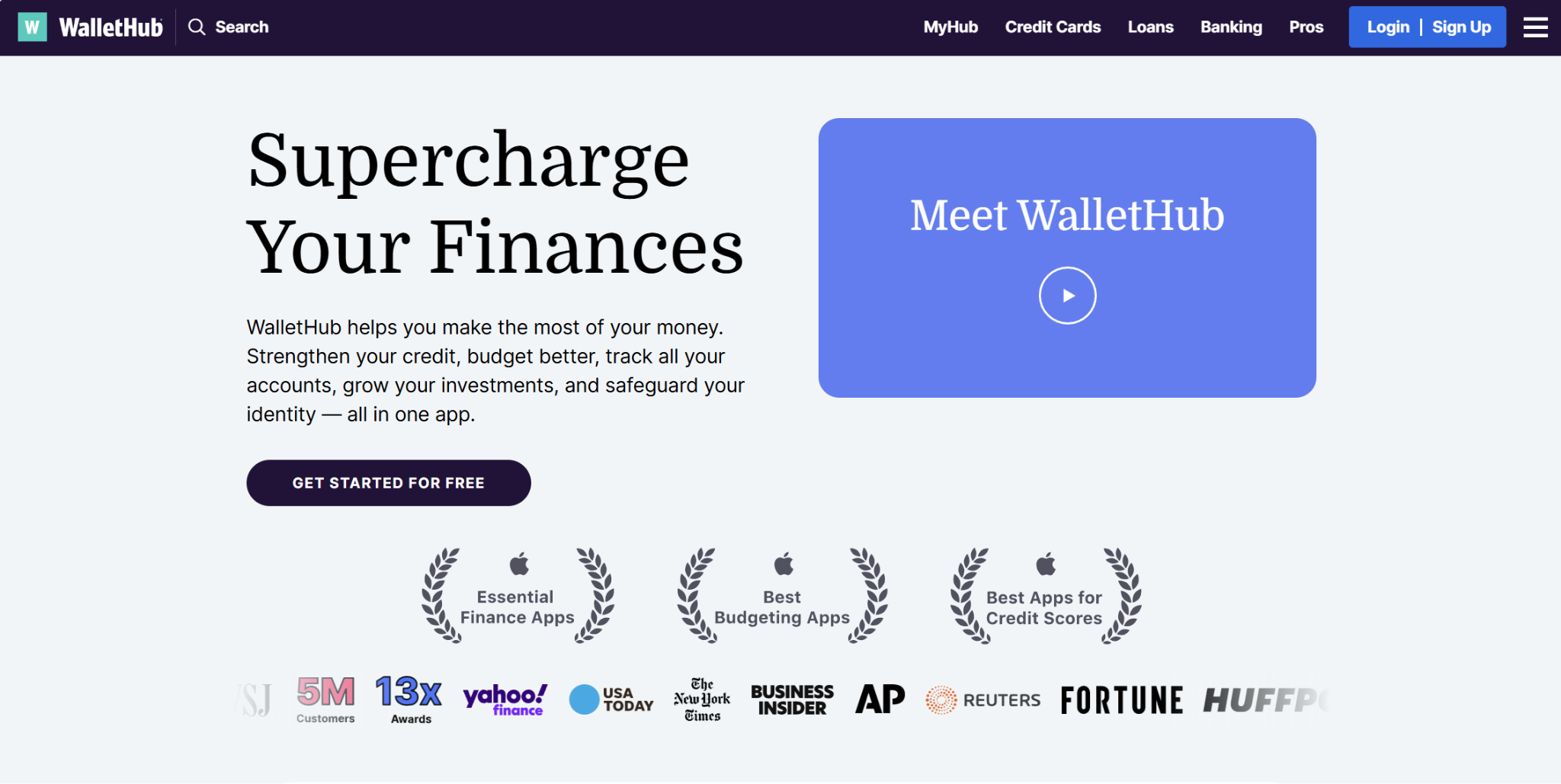
WalletHub is known first and foremost as a place for all things credit. While it certainly delivers in this department, it’s a solid tool for other areas of personal finance too. If you’d like, you can register for an account if you want personalized features for credit, budgeting, identity protection, and investment.
Product Coverage
Beyond credit cards, you can use WalletHub to compare financial products like loans (car, home equity, mortgage, personal) and banking (checking, savings, CDs, money market). You can also use it to connect with financial advisors, insurance agents, real estate agents, and mortgage brokers in your area.
While WalletHub may not cover quite as many product categories as some competing sites, it gives you an extensive database of choices. For credit cards, WalletHub’s team went through over 1,500 choices, and you’re also presented with over 1,000 savings accounts to compare.
Filtering Depth
WalletHub has a strong filtering system in place. For instance, if you’re looking at credit cards, you can narrow down the list based on the card network, balance transfer fee, foreign transaction fee, your credit score, and whether a card is secured or unsecured. If you’re comparing savings accounts, you can filter for the deposit amount, location, institution (banks vs. credit unions), monthly fee, and account type (online vs. traditional).
Ratings and Reviews
WalletHub publishes both user reviews and editorial ratings, but it depends on the product. For example, while credit cards and savings accounts have both ratings, mortgages only have user ratings (and a review if they’d like to publish one). Some of the products also have more detailed WalletHub reviews, covering key features and highlights.
Financial Education
WalletHub has several articles (many of which are studies or awards), such as “The Best Real Estate Markets” or “Property Taxes by State.” There’s also a section for financial education guides, and while there are plenty of articles here, it can be difficult to navigate because it doesn’t let you filter by topic.
Pros
- Extensive product database
- Plenty of filters
- User ratings and reviews
Cons
- Number of choices could be intimidating
- Can’t use it to compare insurance providers
- Potentially confusing article library
Finder: Best for Cryptocurrency
Finder covers financial products for both individuals and businesses. It’s best known for its Finder Rewards program, where members can receive cashback offers for products like investment and bank accounts. However, you don’t have to be a Finder member in order to start comparing.
Product Coverage
Finder covers four main product categories:
- Banking: Checking, high-yield savings, CDs, money markets, credit cards
- Investing: Online brokers, IRA accounts, robo advisors, cryptocurrency
- Lending: Personal loans, cash advance apps, mortgages
- Business: Loans, banking, credit cards
It gives you a range of choices for each product type, but the amount depends on which product you’re looking at. For instance, Finder showed me 18 savings accounts, 51 personal loan options, and 33 credit cards.
Filtering Depth
For many products, there are strong filtering systems in place to hone in on your top choices. When looking at checking accounts, for example, you’ll see filters for account features, deposit methods, account type, and states serviced. For credit cards, you can filter by card type, features, issuer, and rewards type. Also, specific to credit card rewards, Finder has a filter for crypto rewards, which most other sites don’t have.
Ratings and Reviews
Finder assigns each product a Finder Score out of 10 possible points. The methodology differs depending on the product type, but the site is transparent about the variables and how they’re weighted. Many, but not all, of Finder’s products have an in-depth editorial review covering the advantages and drawbacks. Some products also have user reviews.
Financial Education
Like other sites, Finder also has resources for learning more about personal finance in general, but they are somewhat buried within the site. Once you find them, they’re solid resources; as an example, there’s a guide called “What Is a Traditional Savings Account” that breaks down the basics.
Pros
- Plenty of financial products available
- Can filter for crypto products
- Both user and editorial reviews
Cons
- Not all products are reviewed
- Can’t use it to compare insurance providers
- Difficult to navigate to the educational guides
What’s the Best Website for Comparing Financial Products?
Ultimately, it comes down to a couple of things: the type of product you’re shopping for and the online experience you have in mind.
Let’s say you’re looking for a new insurance policy. Of the sites I mentioned here, only BestMoney and NerdWallet would work for this. The other sites have their own strengths, such as WalletHub with its extensive database (especially for credit cards), Bankrate being the top performer for mortgages, and Finder for having crypto-related products on its site.
But no matter what, I’d recommend visiting more than one site to get a well-rounded look at your options.