
Share this
Opening a high-yield savings account of any kind puts you ahead of many savers, but you should still take your choice of bank seriously. With the vast amount of options that are out there, it’s especially crucial to research features like APYs, fees, and minimum balance requirements before opening an account.
So here’s a look at some of the best Online Banking Comparison Sites for High-Yield Savings Accounts:
At a Glance
| Best For | Pros | Cons | |
| BestMoney | Quick research and usability | -Great for quick research -Scores and reviews for each bank -Savings calculator | -No filters -No user reviews -Limited number of banks |
| DepositAccounts | In-depth bank research | -Bank filtering -User reviews -Children’s savings accounts | -No editorial reviews -Overwhelming number of banks -Banks are buried underneath promotional offers |
| NerdWallet | Banking education | -Editorial ratings and reviews -Historical APY data -Savings calculator | -No filters -No user reviews -Limited number of banks |
| Bankrate | APY comparisons | -Extensive bank coverage -Editorial scores and reviews -Savings calculator | -Some banks unrated -No student or children’s accounts -No user reviews |
| WalletHub | Side-by-side comparisons | -Extensive bank coverage -Bank filtering -Side-by-side comparison | -Relies heavily on user reviews -No in-depth editorial reviews -No overall ranking list |
BestMoney: Best for Quick Research and Usability
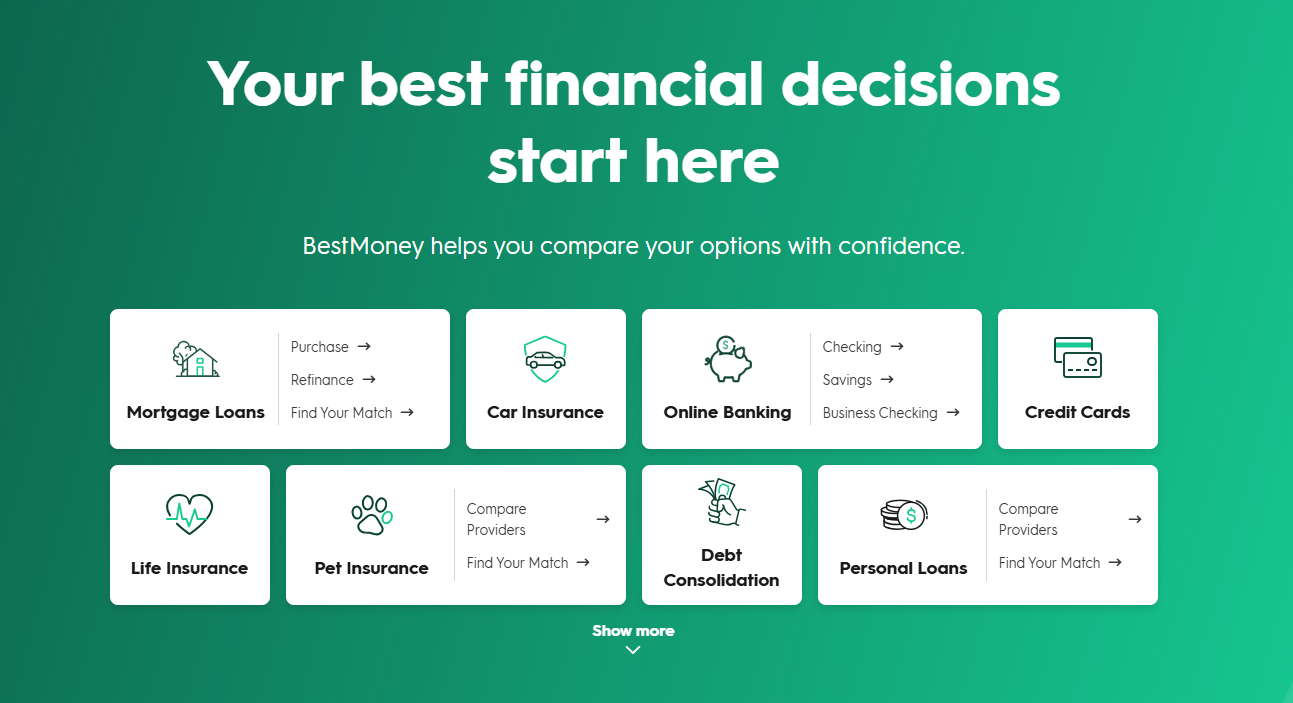
BestMoney covers everything from insurance to loans to investments, but it’s also a useful tool for comparing online banks, including high-yield savings, checking, and business accounts.
Bank Coverage and Filters
BestMoney’s curated list of the best online savings accounts is fairly brief compared to some competitors — it includes just nine banks in total. There are some advantages to this, since the editorial team has already done the hard part for you and selected the best of the best.
Because the list is fairly brief, BestMoney doesn’t have filters for narrowing down the contenders or sorting by factors like APY. One downside is that the limited number of banks could cause you to potentially miss out on the most optimal accounts for your situation.
However, BestMoney still clearly indicates the APY for each bank, and because there are so few, it’s easy to compare even without a filter. For some banks, you can access this APY through a bonus offer, while for others, it’s the standard APY. Interest rates are kept current as well, so you don’t have to worry about making decisions based on outdated details.
For all nine savings accounts, BestMoney also highlights whether any monthly fees or minimum balance requirements apply.
Ratings and Reviews
BestMoney’s bank rankings are out of a total of 10 possible points and combine three factors: popularity, brand reputation, and features and benefits. Popularity is weighted at 50%, brand reputation at 25%, and features at 25%.
Additionally, there are in-depth reviews of the banks, covering important factors like interest rates, fees, customer service, mobile banking, and security. Notably, the only reviews presented on BestMoney are from their editorial team — there’s no section for users to leave their own feedback about the accounts.
Financial Education
Besides its function as a comparison tool, BestMoney helps visitors learn about finances in general to improve their knowledge and decision-making. The site has several articles and guides about online banking, discussing topics like compound interest, how to switch banks, and minimum balance requirements. It also has a savings calculator to help illustrate how your money could grow.
Pros
- Great for quick research
- Scores and reviews for each bank
- Savings calculator
Cons
- No filters for APYs, fees, or minimum balances
- No user reviews
- Limited number of banks
DepositAccounts: Best for In-Depth Bank Research
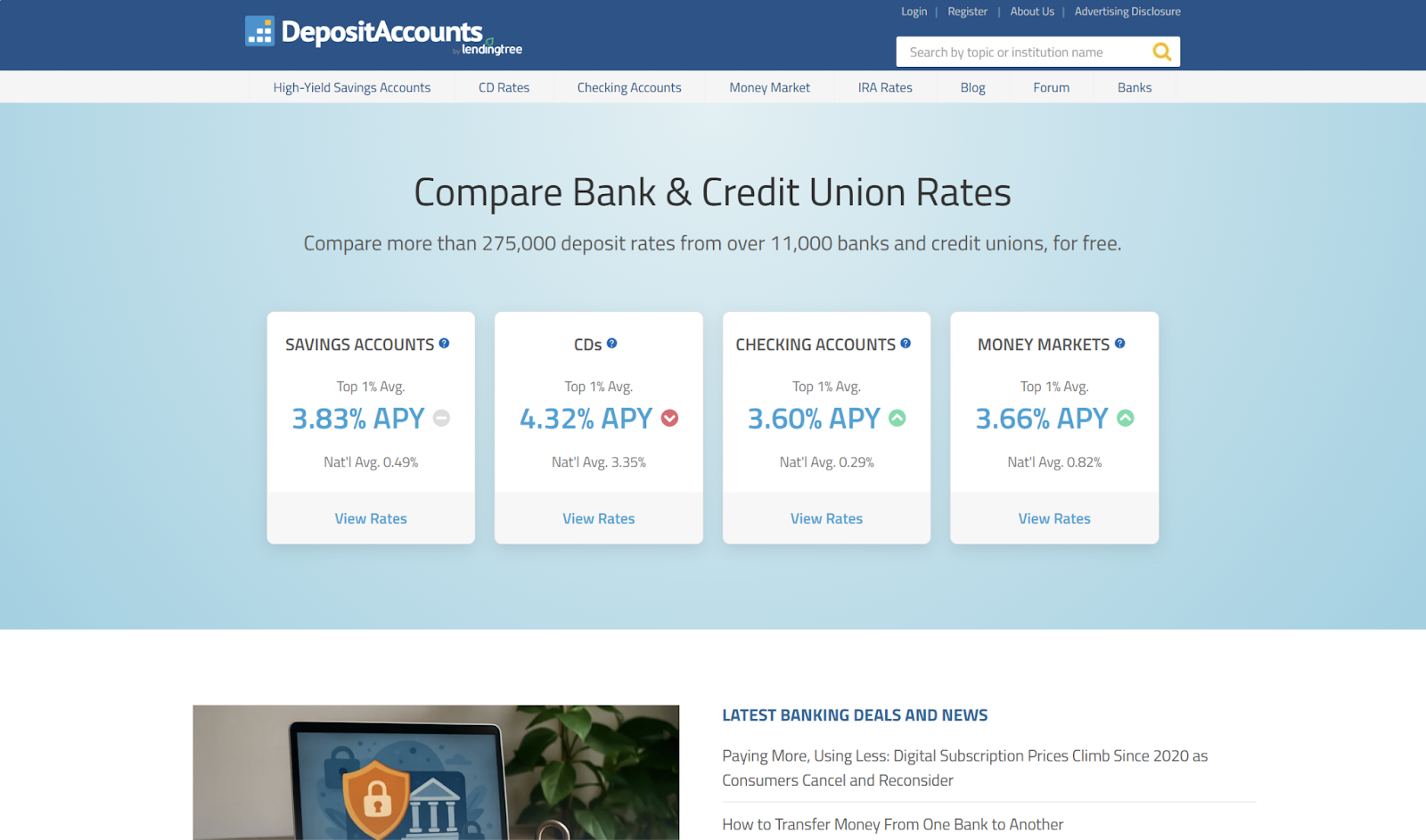
Unlike many other financial comparison sites, which cover a broad spectrum of products, DepositAccounts focuses solely on banking. So while it won’t help you if you need to research insurance or credit cards, it’s a reliable resource for researching high-yield savings accounts, checking accounts, CDs, money market accounts, and IRA savings accounts.
Bank Coverage and Filters
DepositAccounts contains rate information on over 11,000 banks and credit unions, making it an ideal resource if you’re planning to conduct extensive research. Beyond personal savings accounts, DepositAccounts presents details on business and student accounts.
The site has several filters, including location and deposit amount, allowing you to quickly view the banks that fit your personal requirements and preferences. You can also choose whether you want to view banks, credit unions, or both. To easily access the highest APYs, you can sort from highest to lowest.
While the main focus for most people is on a savings account’s APY, DepositAccounts additionally presents clear information on any service charges, minimum deposits, and minimums to earn interest at each bank. For all three, you can sort from lowest to highest, which can help you hone in on the banks with the lowest fees.
Ratings and Reviews
You can explore DepositAccounts’ Bank Reviews section to read through user reviews of each bank and get a sense of what your banking experience might be like. But because DepositAccounts really focuses on user reviews, it doesn’t include in-depth editorial reviews that detail the ins and outs of critical factors like customer service and security. Instead, it assigns each bank a rating out of five stars, with scoring based on overall value, digital banking, customer satisfaction, health and stability, and availability.
Financial Education
DepositAccounts’ blog helps you improve your financial literacy, covering topics like money transfers, how savings accounts work, and banking with foreign currencies. The site also provides several banking calculators and tools, such as a compound interest calculator and a map of bank rates nationwide.
Pros
- Bank filtering
- User reviews
- Covers children’s savings accounts
Cons
- No in-depth editorial reviews
- Potentially overwhelming number of banks
- List of banks buried underneath promotional offers
NerdWallet: Best for Banking Education
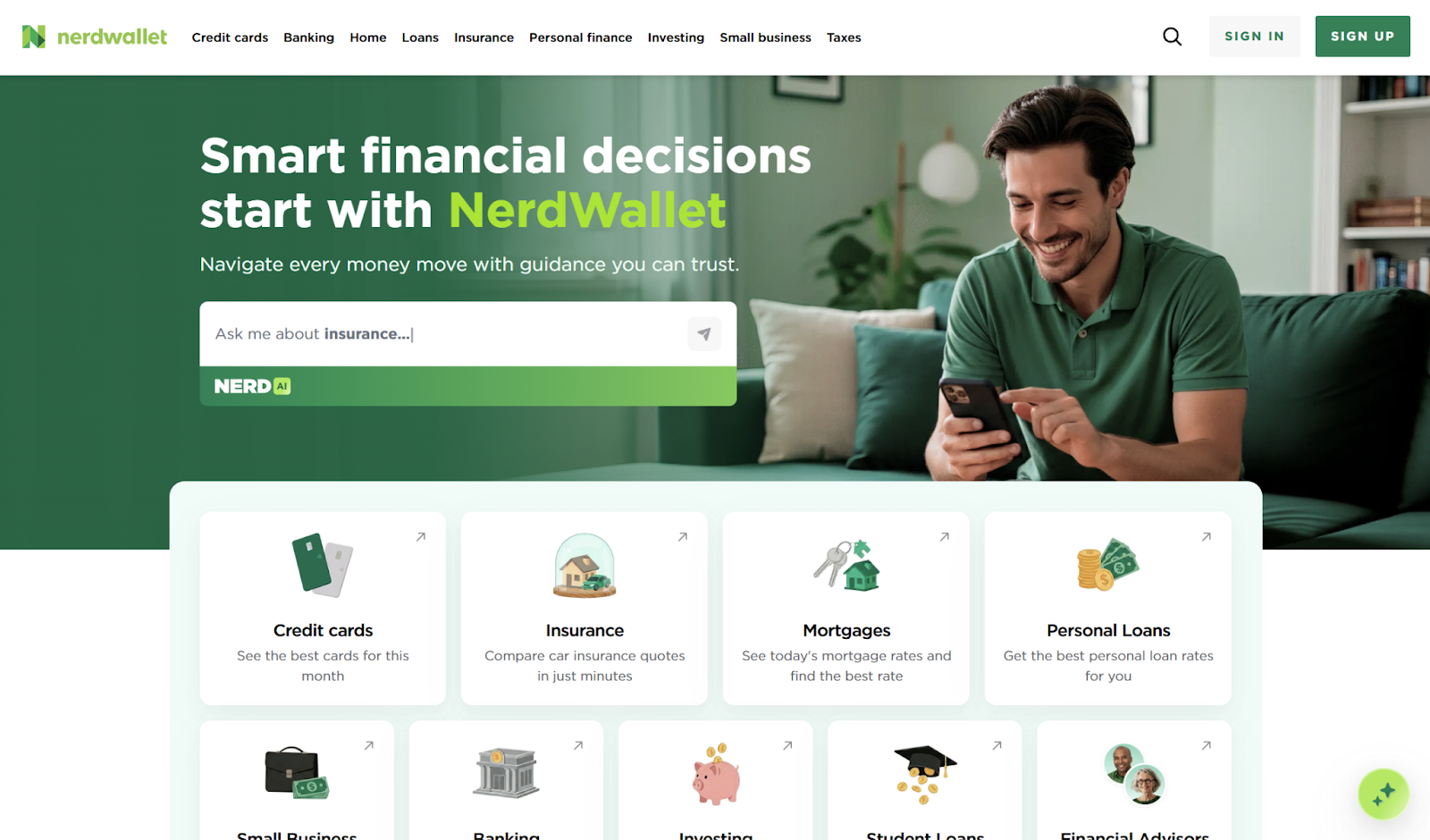
NerdWallet is a well-known source of information for all things personal finance, improving financial literacy through its articles and letting you compare products like credit cards, insurance, and bank accounts.
Bank Coverage and Filters
NerdWallet’s list of the best high-yield savings accounts contains just 14 banks. Since the list is fairly short, it doesn’t contain any filters for factors like APYs or fees. Instead, you’ll have to read through the list manually to find the banks that are most suitable for your situation. For high-yield savings accounts, NerdWallet’s scope extends beyond its 14 top picks, but it’s still minimal compared to some competing sites.
NerdWallet includes the APY for each bank it presents on its site, additionally noting whether there are minimum balance requirements or monthly fees.
Ratings and Reviews
NerdWallet assigns each bank a score out of five stars and thoroughly reviews it, covering pros/cons, APYs, and the customer experience. Notably, NerdWallet only has editorial reviews; there’s no section for users to provide their own input.
Financial Education
For the broader topic of banking, NerdWallet has articles covering various subjects, such as the difference between saving and investing, how to establish an emergency fund, and how to make a savings plan. Specific to high-yield savings, NerdWallet presents historical APY data that helps you see how interest rates have changed over the past few years and how they might evolve over time. It also includes a savings calculator that you can use to explore how your money could grow in the future.
Pros
- In-depth editorial ratings and reviews
- Historical APY data
- Savings calculator
Cons
- No filters for APYs, fees, or minimum balances
- No user reviews
- Limited number of banks
Bankrate: Best for APY Comparisons
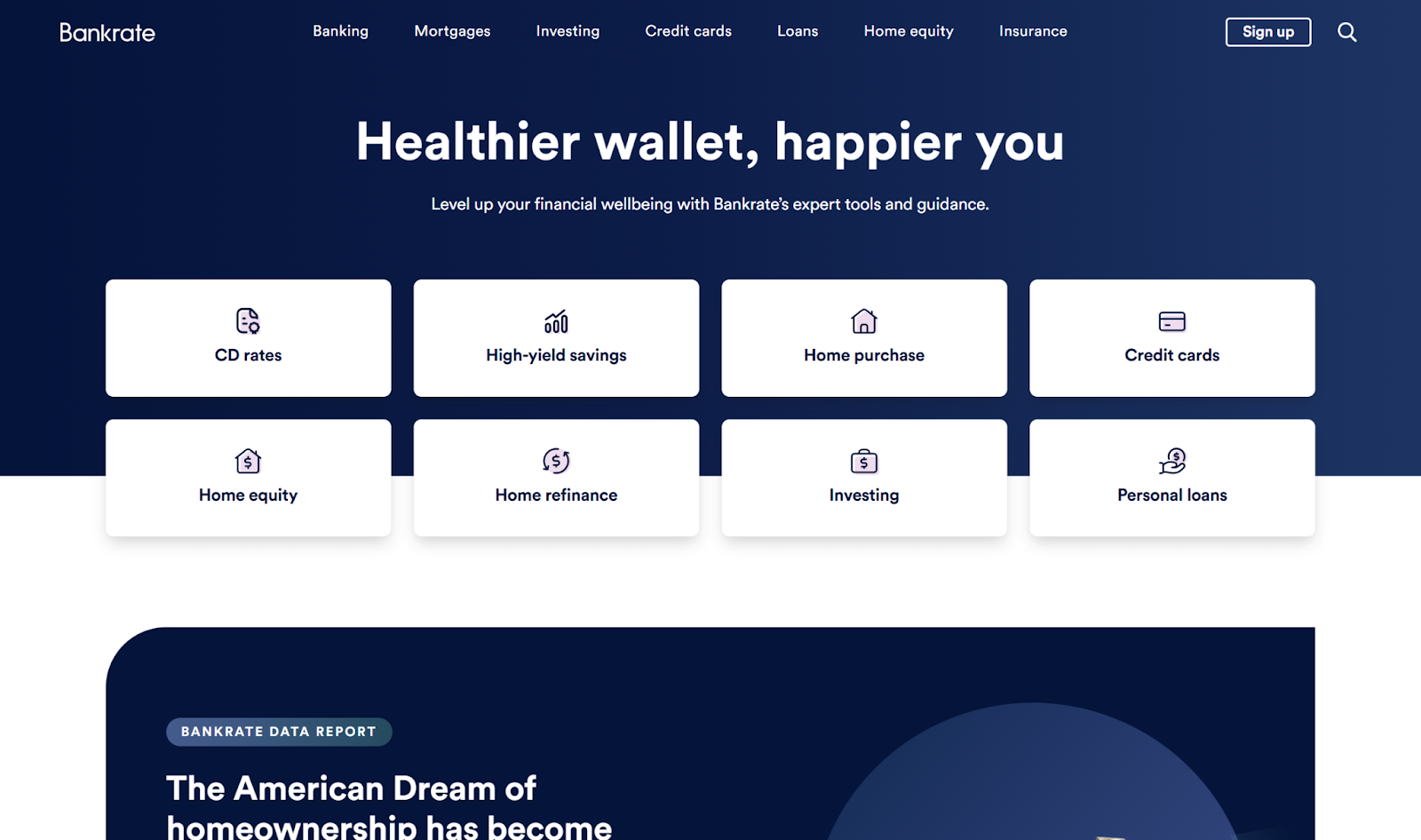
Although Bankrate can be a useful resource for learning more about personal finance in general, its main specialty lies in comparing rates. However, some of the other products that it covers include mortgages, credit cards, investments, loans, insurance, and (extensively) high-yield savings accounts.
Bank Coverage and Filters
Bankrate currently lists the APYs and minimum balances for around 100 high-yield savings accounts. This number far exceeds some competitors, so you have the freedom to get highly specific in your wants and needs if desired. However, it doesn’t include information specific to student and children’s savings accounts.
To help you wade through the lengthy list of banks, Bankrate lets you sort by APY and minimum balance requirements. You can also input your deposit amount and zip code to personalize your search. Finally, you can compare up to three banks at once side by side, highlighting the differences in APYs, minimum balances, and estimated earnings for your deposit amount.
Ratings and Reviews
For most banks, Bankrate offers a score out of five possible stars, ranked by factors like APYs, minimum open deposit requirements, and minimum balances. Beyond these star ratings, Bankrate also provides full reviews, covering a bank’s APY history, customer experience, and digital experience.
But while the site provides scores and reviews for most banks, it doesn’t for all of them. This makes it difficult to judge the unrated banks, and you’d have to rely on other sites for more details on them. Additionally, there is no section to read through user ratings or reviews.
Financial Education
Beyond its comparison tools, Bankrate has educational resources covering savings basics, budgeting tools, and average rates. It also has a savings calculator that you can use to get a quick snapshot of what your high-yield savings balance could look like in the future. You just input your initial deposit, monthly contribution, time period, and APY, and the calculator will show your total savings, breaking it down into your initial deposit, total contributions, and interest earned.
Pros
- Extensive bank coverage
- In-depth editorial scores and reviews
- Savings calculator
Cons
- Some banks unrated
- No student or children’s accounts
- No user reviews
WalletHub: Best for Side-by-Side Comparisons

WalletHub is best known for its credit card information and credit card monitoring tools, but it can also help you compare loans and bank accounts — including HYSAs.
Bank Coverage and Filters
WalletHub contains information on over 1,000 savings accounts (including plenty of filters to help wade through them), so you’re almost guaranteed to find an account that fits your needs. You can choose whether you’re a general consumer, a business, or a college student, and you can filter by institution (bank vs. credit union), monthly fee, and account type (online-only vs. traditional). You can also sort by APY to find the highest rates.
Also, once you’ve begun to narrow down your list, you can use WalletHub’s side-by-side comparison tool to compare up to seven accounts at once. This gives you a quick look at how they stack up when it comes to factors like APYs, monthly fees, account minimums, and signup bonuses.
Ratings and Reviews
While WalletHub’s editorial team assigns banks an overall score out of five stars, it doesn’t contain any in-depth write-ups on them. There also isn’t a master list ranking the banks. As such, it can be a bit difficult to get an idea of the particular nuances of any particular bank.
Instead, WalletHub relies heavily on user reviews and rankings (scored out of five stars).
Financial Education
Besides its function as a comparison tool, WalletHub has an extensive library of financial education guides. While most of their educational articles are about credit cards, some of the guides cover topics like budgeting. The site also has several savings calculators, including those for compound interest, net worth, simple interest, and emergency savings.
Pros
- Extensive bank coverage
- Bank filtering
- Side-by-side comparisons
Cons
- Relies heavily on user reviews
- No in-depth editorial reviews
- No overall ranking list
Finding the Best Comparison Site for High Yield Savings Accounts

In the age of online banking, there are seemingly endless options out there for high-yield savings accounts. But while it’s good to have more options, it can also complicate the decision. That’s why it’s important to do your research and visit several financial comparison sites before opening an account.
Of the sites mentioned here, it’s good to start with a platform like BestMoney or NerdWallet, which publish more abbreviated lists of banks. These sites have already done the hard part for you, narrowing down the options so you don’t have to do it yourself.